From Concept to Market — Faster with 3D

Your new range is ready. The product team signed off. Sales are waiting. And then someone asks: when will the visuals be ready?
For most furniture manufacturers, that question triggers a familiar delay. Book the photographer. Source the props. Ship the samples. Wait for the shoot date. Wait for editing. Wait for approvals. Six to ten weeks later, your catalogue is ready — and your launch window has already moved.
3D changes that equation.
The Traditional Shoot Problem
Physical photography made sense when your range changed once a year and you had three weeks to prepare for a trade show. It does not make sense when you're managing 200+ SKUs across four colorways, updating ranges twice a year, and trying to get product pages live before your competitors do.
The cost is not just the shoot day. It's the sample lead time. It's the studio booking. It's the art director, the stylist, the retoucher. It's the three rounds of amends because the fabric looks wrong under the lighting. It's the six-week gap between sign-off and live assets — during which your sales team is working off renders from two seasons ago.
For brands running large catalogues, this is not a photography problem. It's a production pipeline problem.
What 3D Changes
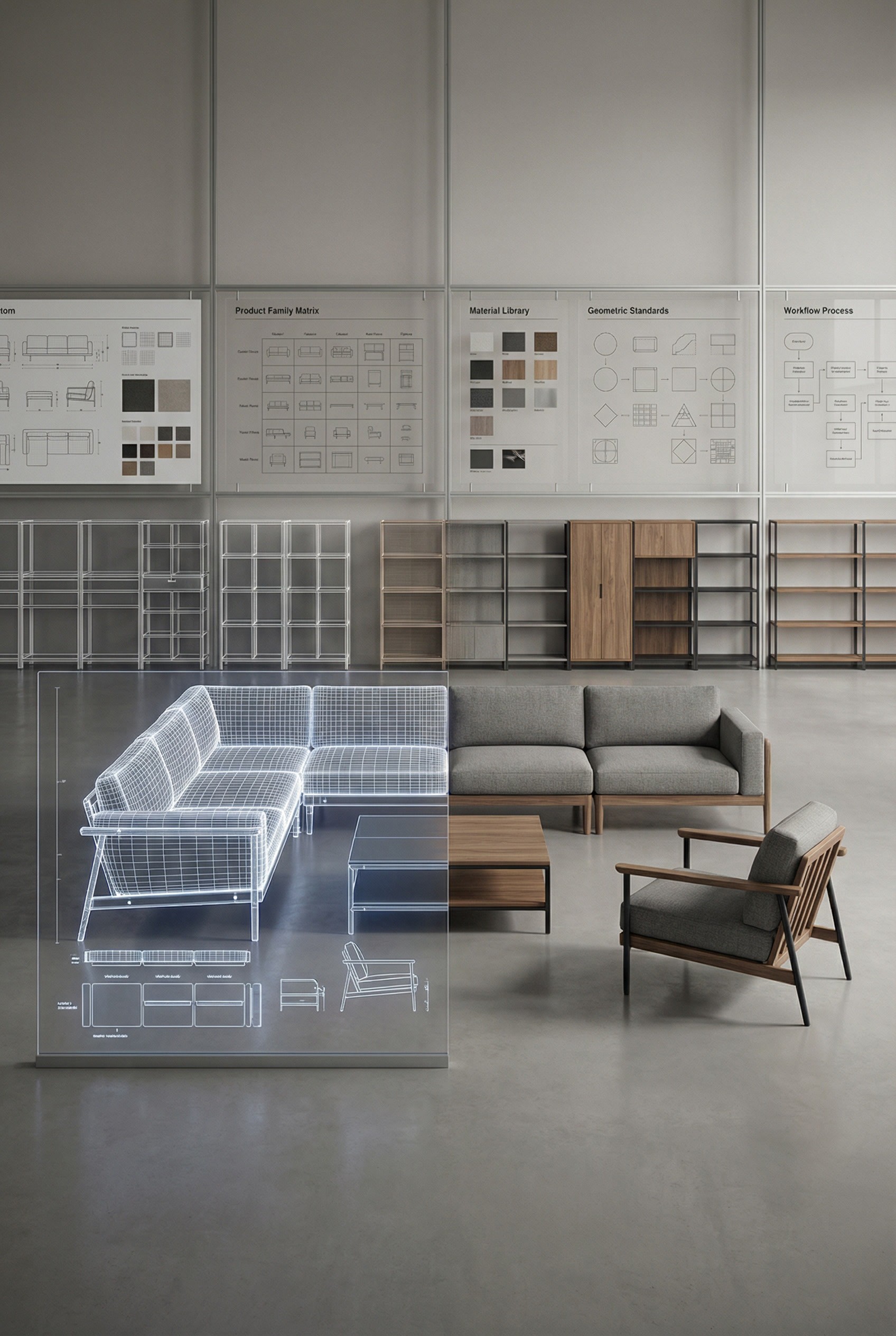
When your product exists as a spec-accurate 3D model, your catalogue refresh doesn't start at the shoot. It starts at approval.
New colorway approved? Swap the material. Render. Done.
New fabric supplier? Update the texture map. Render. Done.
Product discontinued? Archive the file. No wasted shoot cost.
New market requiring localised roomset styling? Build the scene once, relight for each region.
The model becomes a production asset — reusable, version-controlled, consistent across every output. Not a photograph that has to be retaken every time something changes.
The Numbers That Matter
For a range of 50 SKUs across 4 variants each, traditional photography means 200 individual shot setups — minimum. At even a conservative estimate, that's a multi-week shoot, a significant logistics overhead, and a per-SKU cost that compounds with every range update.
With a mature 3D pipeline, those 200 variants render from a single model set. New variants cost a fraction of the first. Updates take hours, not weeks. And every image is pixel-consistent — same lighting, same framing, same brand standard — across every SKU.
What Fast Actually Looks Like
The brands getting their ranges to market fastest are not the ones with the best photographers. They are the ones who built a visual production system that runs parallel to product development — not after it.
They brief 3D modeling at the same time as tooling sign-off. They approve materials digitally before samples exist. They have render-ready assets the week the product is finalised — not six weeks after.
That is the operational advantage 3D creates. Not prettier pictures. Faster pipelines.
Where to Start
If your current process relies on physical shoots for every catalogue update, the quickest ROI is identifying your highest-churn SKUs — the products that get updated most frequently — and modelling those first.
Once the model exists, every subsequent variant, colorway, or contextual scene costs a fraction of the original. The pipeline pays for itself on the second update cycle.
If you're refreshing a range this quarter and want to understand how a 3D production model would work for your catalogue, book a scoping call. We'll map out the pipeline against your specific SKU volume and delivery cadence.
Continue Reading
Accuracy is not detail — it’s the difference between browsing and buying.